We Keep Asking Him to Come
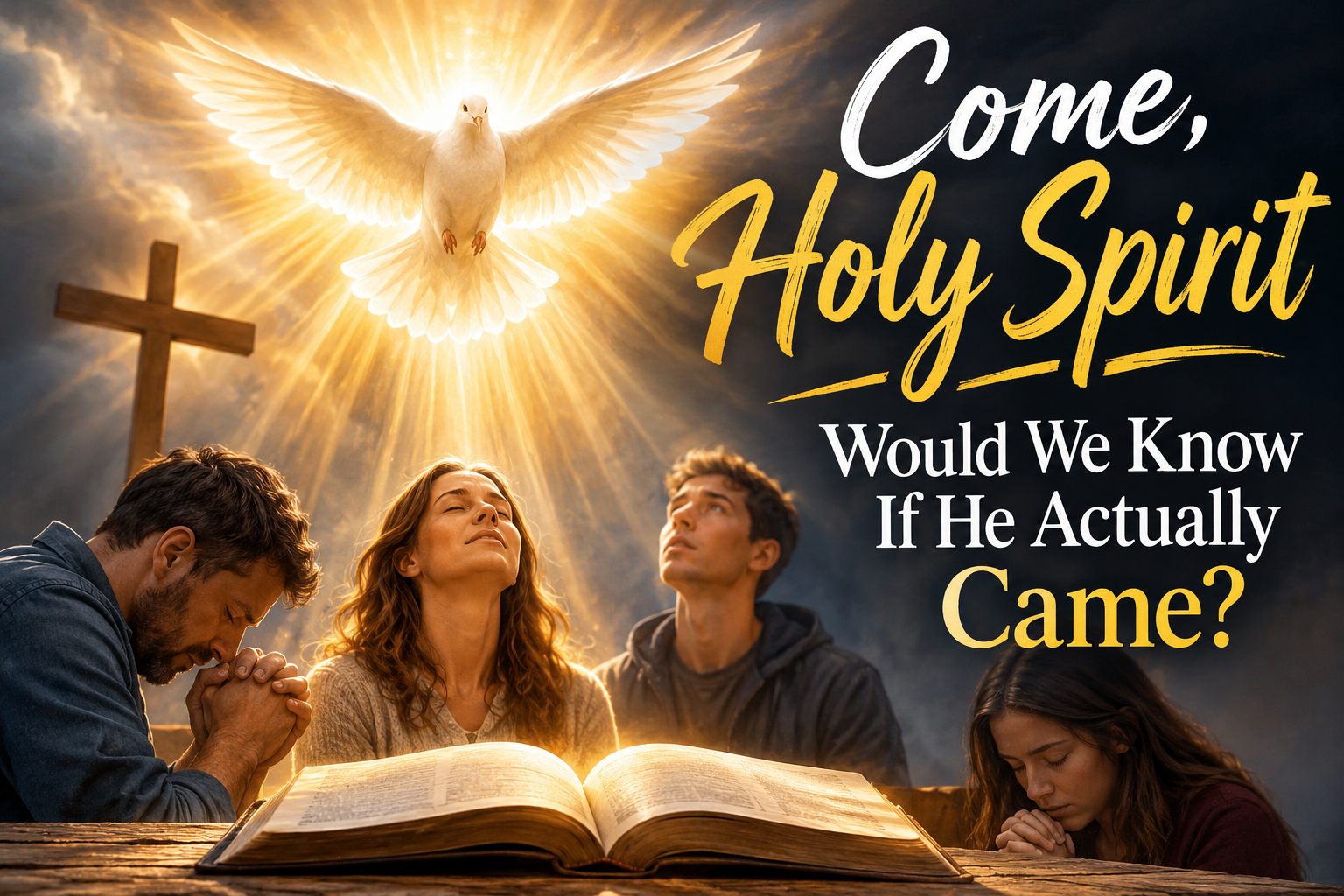
You know the moment. The lights go down a little. The keyboard holds that long, soft note. Somebody at the mic prays, "Holy Spirit, we welcome You here. Come fill this place. Fall fresh on us." Hands go up. Eyes close. Something in the room shifts.
We pray that prayer all the time. Sunday mornings, Wednesday night prayer meetings, alone in the car with worship music turned up. And I love that prayer. But I've had a question rolling around in my spirit for a while now, and I want to ask it with you: if the Holy Spirit actually showed up, would we know it was Him?
I'm not asking that to make anybody doubt their tears or feel bad about their worship. I'm asking because I want us to know Him so well that when He walks in, we recognize Him. The way you know a loved one's footsteps in the hallway, or your best friend's voice on the phone before they say their name.
A Good Longing
Let me say this first, because it matters: wanting more of the Holy Spirit is a good thing. A holy thing. Jesus Himself told us to ask. "If ye then, being evil, know how to give good gifts unto your children: how much more shall your heavenly Father give the Holy Spirit to them that ask him?" (Luke 11:13, KJV).
The Father isn't stingy with His Spirit. He loves it when we ask. And honestly, that hunger you feel for Him? That's Him already at work in you, pulling you closer.
I also want to be clear that our emotions aren't the enemy here. A lot of times they're the echo of His presence. When those two disciples on the Emmaus road finally realized who had been walking with them, they said, "Did not our heart burn within us?" (Luke 24:32, KJV). Their hearts caught on before their heads did. Tears, joy, trembling, raised hands—those are often exactly how a human heart should respond to a holy God.
So I'm not trying to get us to feel less. I want us to know Him more. Then our feelings will rise in response to Him, and we'll know the difference when He's really in the room.
What Happened When He Really Came
The Bible gives us some pictures of what it looked like when God's presence actually filled a place. And what strikes me is this: the focus is never on how good everybody felt. It's on what His coming did.
When Solomon dedicated the temple, the singers and trumpeters lifted up one voice in praise, and the glory cloud filled the house so thick that the priests couldn't even stand to do their jobs (2 Chronicles 5:13–14). The music led them to that moment, but the moment was bigger than the music. It stopped the program cold.
When Isaiah saw the Lord high and lifted up, he didn't shout for joy. He cried, "Woe is me! for I am undone" (Isaiah 6:5, KJV). Then God cleansed him, and then God called him, and Isaiah said, "Here am I; send me."
At Pentecost the Spirit came with wind and fire. People watching thought the believers were drunk. But Peter stood up and preached Jesus, crucified and risen, and three thousand people were cut to the heart and turned to the Lord (Acts 2).
In Acts 4 the believers prayed and the building shook. And what did they do with it? "They spake the word of God with boldness" (Acts 4:31, KJV), and they started sharing everything they had with each other.
At Cornelius's house, the Spirit fell on the people while Peter was still preaching about Jesus (Acts 10:44). He came right in the middle of the Word, not after the Word was set aside.
See the pattern? When He comes, there's holy awe, there's conviction, Jesus is lifted up, the Word is front and center, and people walk out the door different. There were plenty of emotions in those stories, sure. But the emotions came along for the ride. They were never the point, and they were never the proof.
The Weight of His Presence
Here's something I've known for a long time: when the Holy Spirit arrives, He often comes with a heaviness in the air that fills the room. If you've felt it, you know exactly what I'm talking about. If you haven't, it's hard to put into words. The air gets thick. The room goes still. Even the folks who were singing the loudest get quiet.
That's not just my imagination. The Hebrew word for God's glory is kabod, and it literally means weight, heaviness. So when the Bible says the glory of the Lord filled a place, it's telling us that God's weighty presence pressed in on His people.
You see it all through Scripture. When the glory filled the tabernacle, Moses couldn't even go into the tent (Exodus 40:34–35). When the cloud filled Solomon's temple, the priests couldn't stand (2 Chronicles 5:14). At Pentecost the sound of that rushing mighty wind "filled all the house where they were sitting" (Acts 2:2, KJV).
Notice that word: filled. He doesn't just hang around the edges. He fills the place. And when He does, people find they can't stand, can't speak, or just don't want to move, because God is there.
That heaviness is different from an emotional high. Emotion tends to lift us up and make us louder. His weight brings us low and makes us still. Emotion is all about what I'm feeling. His weight is all about Who just walked in.
And when you've felt that weight, nobody has to tell you God is near. You don't need somebody at the mic to announce it. You just know. The same way you know when someone you love has walked into the room behind you.
Gifts That Prepare the Way
God has given us some wonderful gifts for worship: music, each other, beautiful spaces, and our own hearts and emotions. These gifts can get us ready to meet Him. But I'll be honest with you, they can also move us all by themselves. And it helps to know that.
Music stirs us. A slow build, a key change, one voice singing alone—any of those can bring tears. David's harp settled Saul's troubled spirit (1 Samuel 16:23). Music has always reached down deep in us.
Repetition helps truth sink in. Psalm 136 says "for his mercy endureth for ever" twenty-six times! Singing a line over and over softens us, and it turns up our feelings too.
We lift each other up. When I see the person next to me worshiping freely, it gives me courage to do the same. Joy spreads. So do tears.
The setting helps. Dim lights and quiet music help distracted people settle down and focus.
We come with our own story. Grief, a hard week, plain old tiredness—they can leave us tender and quick to feel.
Every one of those is a good gift, and God uses them. But any one of them can stir us up on a day when nothing more is happening. That's why we can't measure His presence by how strong the moment feels. The gifts get the house ready. He's the Guest we're waiting on.
When a Leader Kneels
You've seen this. Maybe you've done it yourself. The leader calls out, "Holy Spirit, come." Then they close their eyes, spread their arms wide, or drop right down to their knees. The room gets quiet, and a lot of folks follow.
There's nothing wrong with that. It's thoroughly biblical. "O come, let us worship and bow down: let us kneel before the LORD our maker" (Psalm 95:6, KJV). Paul wanted people everywhere "lifting up holy hands" (1 Timothy 2:8, KJV). In heaven they fall on their faces before the throne (Revelation 7:11). A leader on their knees is often doing exactly what the moment calls for, and giving everybody else permission to do the same.
But here's the thing. People trust their leaders, so when the leader kneels, the room looks to them to know what's happening. That's a gift, and it's also a responsibility. Our people need to understand that God's presence doesn't depend on what the leader does with their body. The Spirit might be moving powerfully while the leader just stands there, and He might be quiet when every knee in the place is bent.
What matters is the heart behind the posture. And I've found that the surrender that shows up in public usually starts in private. If a leader has already been on their knees before God before the service, they'll carry that surrender onto the platform without needing to show it to anybody.
A Moving Moment, or His Presence?
A moving moment in worship is a good thing. I'll take every one God gives me. But when the Holy Spirit Himself shows up, He brings something more. Here's how I've come to tell the two apart.
A moving moment | When He has come | |
What we notice | The song, the room, the feeling | Jesus Christ, His beauty and His worth |
How the room feels | Warm and uplifting | Weighty, still, full of holy awe |
What happens in the heart | Comfort and encouragement | Comfort, and often gentle conviction and repentance |
Place of Scripture | Enjoyed in song | Opened, alive, and pressing on us |
What it needs | The music, lights, and gathering help carry it | He can come in silence, a hospital room, or one quiet heart |
Effect on relationships | Feeling close to others in the room | Reconciliation, generosity, love that acts |
Where it leads | Wanting the moment to last | Wanting to go and serve Him |
Monday morning | A sweet memory | A changed life |
Both of those can happen in the same service, and a lot of times the first one gets our hearts ready for the second. But that last row says it best: a moving moment fills a room. The Holy Spirit fills a life.
How You Know He's Been There
When the Holy Spirit really moves in a service, a prayer meeting, or your own quiet time, He leaves His fingerprints. Sometimes it comes with a flood of emotion and sometimes it's quiet as a whisper, but the fingerprints are there either way.
Jesus gets bigger. That's the Spirit's whole job—to lift up Jesus (John 16:14). When He's been there, people walk out talking about Jesus, not about the band or the preacher.
Holy awe settles over the room. That weight we talked about. The fear of the Lord isn't being scared of Him. It's reverence. People get quieter, not just louder.
Sin comes into the light, and so does forgiveness. He convicts (John 16:8), but He never condemns His children. Folks confess, make things right, and walk away free, not just after a good cry.
The Word comes alive. A verse you've read a hundred times suddenly pierces right through you (Hebrews 4:12). People get hungry for more of it.
Love starts flowing. Broken relationships get mended. The person nobody talks to gets welcomed. People start giving, just like they did in Acts 4.
People get bold. The early church was filled with the Spirit and went right out and spoke the Word with boldness (Acts 4:31). He doesn't just warm us up; He sends us out.
Pride gets smaller. Nobody's trying to prove how spiritual they are. He makes us smaller and Jesus greater (John 3:30).
It lasts. This is the big one. Weeks later you can still see more love, joy, peace, patience, and self-control (Galatians 5:22–23). The real test of Sunday morning is Wednesday afternoon.
Jonathan Edwards wrestled with this same question during the Great Awakening back in 1741. He said tears and shouting and falling down don't prove anything one way or the other. What matters is whether people are drawn to Jesus, turned from sin, hungry for the Word, and full of love. I think he had it right.
When He Comes and We Miss Him
Sometimes we miss Him simply because He didn't come the way we expected. He's God. He gets to come however He wants. And part of knowing Him is being ready for Him to surprise us.
He might come in a whisper. Elijah stood on that mountain through a wind, an earthquake, and a fire, and the Lord wasn't in any of them. Then came "a still small voice" (1 Kings 19:12, KJV). Some of the holiest moments I've known were the quietest ones.
He might come to convict, not just to comfort. When we pray for Him to fall on us, we usually picture warmth and joy. But sometimes He comes and lovingly puts His finger right on something in our hearts. That's not cruelty. It's His kindness leading us home (Romans 2:4).
He might change the plan. In 2 Chronicles 5 the priests couldn't carry on with the service because the glory filled the house. If we leave a little room in our plans, it's a whole lot easier to follow Him when He moves.
He might move in one heart instead of the whole room. The Spirit sent Philip down a desert road for one man from Ethiopia (Acts 8:29). The Lord opened Lydia's heart down by a riverside (Acts 16:14). Sometimes the deepest thing God does in a service happens quietly in one person while everybody else just keeps singing.
And He might come when the feelings don't. I've sat with plenty of folks who are grieving, depressed, or just worn out, and worship feels flat to them. I want them to hear this: the Spirit is still praying for you, with groanings too deep for words (Romans 8:26). His presence isn't measured by how much you can feel right now.
The Invitation We Took Back
I've been in more than one service where the church really, sincerely invited the Holy Spirit to come. We prayed it. We sang it. "Come, Holy Spirit. Fill this place." And then—because of the clock—there was no room for what we'd just asked for. The worship leader rolled right into the next song, or the pastor stepped up and started the sermon.
And I could sense it. We had invited Him, and then we sent Him away before He could do what He came to do. It was like we said, "Come on in!" and then, right as He got to the door, "PSYCH!" I believe He was left grieving.
I don't say that lightly. The Bible tells us plainly that the Holy Spirit can be grieved (Ephesians 4:30). He's a Person. And persons get hurt when an invitation turns out not to be real.
Think about it this way. Say you call up a dear friend and tell them, "I really want you to come to dinner. Please come." They drive across town, they knock on the door, and you're already clearing the table because you're running behind. You'd never do that to a friend on purpose. But we do it to the Holy Spirit sometimes and don't even notice.
There's a tender picture of this in the Song of Solomon. The beloved comes knocking at night and says, "Open to me." The bride takes her time getting up. And by the time she opens the door, "my beloved had withdrawn himself, and was gone" (Song of Solomon 5:2, 6, KJV). He came. She meant to let him in. She just didn't open the door in time.
Now, I don't believe this comes from bad hearts. Most of us have done it. We do it because we're busy, because there's a nursery schedule and a second service, because the bulletin was printed on Wednesday. But it leaves a question every one of us can ask: if we invite Him, are we willing to wait for Him? I'd rather pray a smaller prayer and mean it than ask Him to come and then leave Him standing on the porch.
Making Room for Him
We can't put the Holy Spirit on a schedule. But we can quit crowding Him out. Here are a few simple ways to make room for Him, whether you're leading a gathering or worshiping on your own.
If you lead worship or prayer
Pray the invitation with open hands. Ask Him to come, and hold your plan loosely in case He wants to take things somewhere else.
Let people meet Him for themselves. Point them to Jesus and trust the Spirit to make Himself known in each heart.
Leave some room for stillness. A few unhurried minutes of quiet can be right where that weight of His presence settles in.
Keep the Word in the middle of it. Read Scripture out loud in worship. The Spirit loves to work through what He wrote.
Give people a way to respond. Leave room for them to confess, forgive, make something right, or pray for somebody by name.
Listen for the fruit. Pay attention to the stories you hear in the days after a service. They'll tell you more about what God did than how it felt at noon on Sunday.
In your own time with God
Enjoy the songs and the silence. Worship with music, and sometimes just sit quiet with your Bible open and wait on Him.
Ask Him what He's saying. Before you get up, ask, "Lord, what do You want me to do with this?"
Answer His nudges. A lot of times His nearness shows up as a gentle push to love somebody, forgive somebody, or make something right.
Look back and say thank You. A week after a powerful moment, look at what it's grown in you, and thank Him for it.
Would We Know?
So the next time we sing "Come, Holy Spirit," let's pray it with our eyes open as well as our hearts. We're not asking for a feeling or a vibe or a moment. We're inviting the holy God—the One who comes to make Jesus big, to bring sin into the light and heal it, to open up His Word, and to send us out changed.
If that's Who we're asking for, we'll learn to recognize Him. Sometimes He comes with wind and fire. Sometimes He comes in a whisper. Sometimes the air just gets heavy and the whole room goes still. Either way, He leaves fingerprints that last long after the last song is over.
And when He does come, friend, let's not say "Psych." Let's open the door, and let Him stay.
Questions to Sit With
1. When I pray "Come, Holy Spirit," what am I really expecting to happen?
2. Can I remember a worship moment that felt powerful but didn't change a thing? How about one that felt quiet but changed everything?
3. Would I welcome Him if He came to convict me instead of comfort me?
4. How much of my sense of His presence depends on the music, the lights, or the crowd?
5. What's still growing in my life from the last time I really met Him in worship?