She'd been sitting across from me for maybe ten minutes, mostly talking about work, when she finally got to it.
"My husband says I guilt-trip him." She picked at the edge of her sleeve. "Is he right? Am I one of those manipulative people?"
(I've changed the details to protect her privacy, but I've heard some version of that question more times than I can count.)
What struck me wasn't the question itself. It was the fear behind it. She wasn't really asking about a habit. She was asking whether something was wrong with her, deep down.
I'll tell you what I told her. In all my years of chaplaincy and counseling, the people who are truly bent on controlling others almost never lose sleep wondering if they are. If you're worried about it, that tells me your conscience is awake. That's a good thing. But it's also worth an honest look, so let's take one together.
So where's the line?
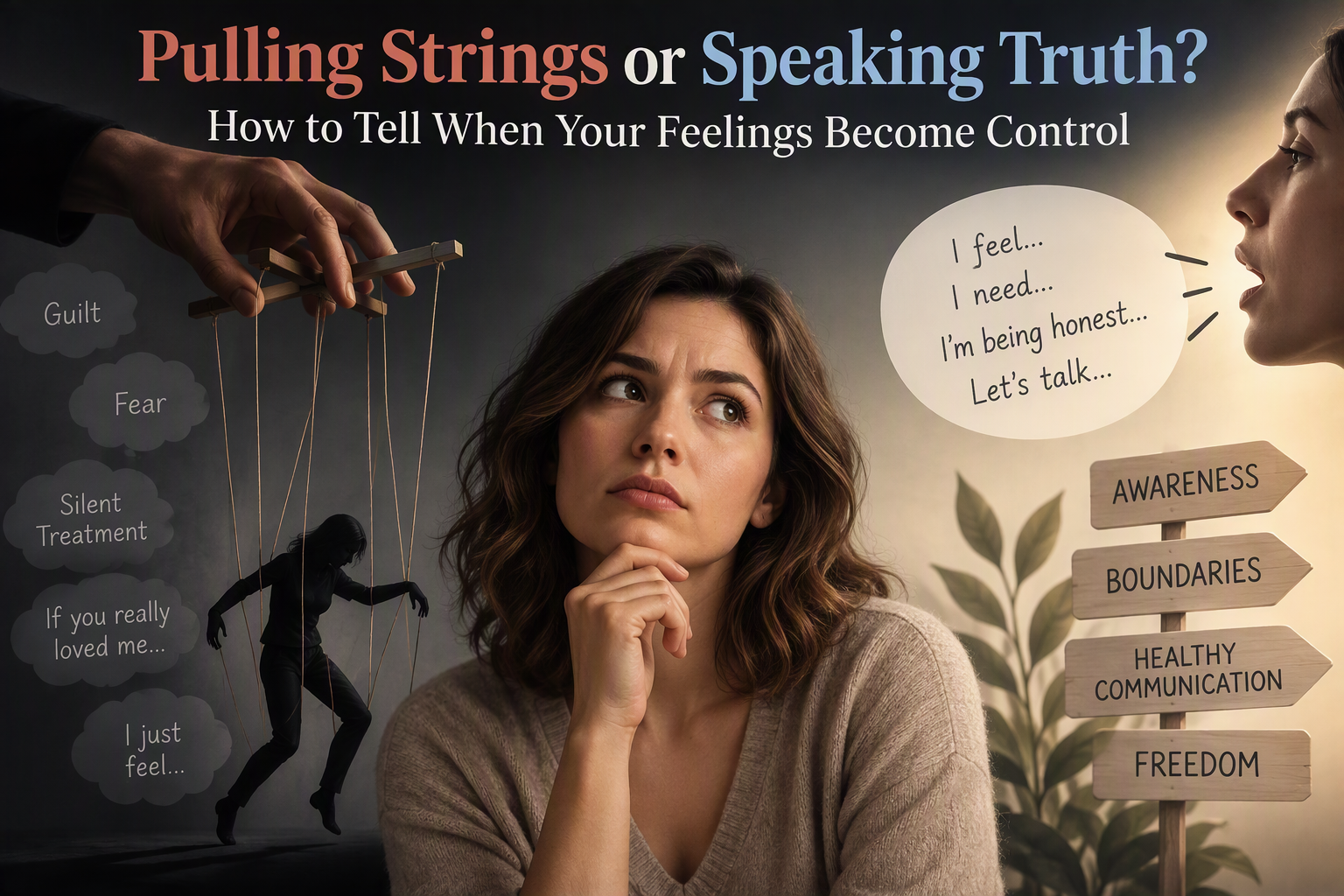
Here's how I think about it. Expressing a feeling is handing someone a piece of your heart and saying, "This is what's going on in me." Manipulation is using that feeling as a lever to move them where you want them to go.
When I'm sitting with someone trying to sort out which one they're doing, I usually ask three questions.
First, can they say no? If the honest answer is "Sure, but they'll pay for it with three days of me being cold," then it wasn't really a request.
Second, am I actually saying what I want? Or am I sighing, hinting, and dropping comments, hoping they'll figure it out and feel bad enough to fix it?
Third, am I trying to get closer, or trying to win? Sharing your hurt invites someone in. Using your hurt to back them into a corner pushes them away, even if they give in.
Nobody passes all three every time. I certainly don't. But they're good questions to have in your pocket.
How we get tangled
Most of us never decide to manipulate anybody. We just grab whatever worked the last time we were hurting. See if any of these sound familiar.
There's the hint. "I guess nobody remembered I had my procedure this week." What we really mean is, "I wish you'd checked on me." So why not just say that?
There's the scorecard. "I always do the dishes, but whatever." That whatever is carrying a lot of weight. It's usually a fair request wrapped in resentment.
There's the cold shoulder. One-word answers for days, and the other person is left guessing what they did. Needing space is completely okay. Leaving someone in the dark isn't. "I'm hurt and I need a little time, but I'll come find you tonight" changes everything.
There's the test, where we pull away just to see if they'll come after us. And there's the threat: "Fine. Maybe I should just leave." Both usually come from a scared place that wants reassurance but doesn't know how to ask for it.
One more thing, because people ask me about it a lot: crying during a hard conversation is not manipulation. Tears are just what pain looks like sometimes. It only becomes a problem if the tears are being used to end a conversation that really needs to happen.
Where it comes from
Almost every one of these habits started out as a way to survive.
The kid whose needs got brushed aside learns that asking straight out doesn't work, so they learn to hint. The kid in a loud, angry house learns that going quiet is the safest place to be. The kid who only felt loved when they were "being good" learns to keep careful track of who owes what.
It made sense back then. It kept us safe. The trouble is that what protected a frightened eight-year-old can end up hurting a spouse, a friend, or our own kids thirty years later.
Fear plays into it too. When we're scared of losing someone, we tend to ask "Are we okay?" over and over, or test them to be sure. That longing to feel secure isn't bad. God put it there. It just needs a better road to travel.
And if you carry a mental health diagnosis, please hear me on this: a diagnosis is not a verdict on who you are. Some of the most loving people I've ever known live with a deep fear of being abandoned. With the right support, they learn new ways to ask for what they need, and so can you.
What I keep finding in Scripture
One of my favorite moments in the Gospels is when blind Bartimaeus is shouting for Jesus from the side of the road. Jesus stops, turns to him, and asks, "What do you want me to do for you?" (Mark 10:51).
I've always loved that. Jesus knew exactly what the man needed. Everybody did. But He still gave him the dignity of saying it out loud. There's something holy about naming what you need plainly.
Jesus put it simply elsewhere: let your yes be yes and your no be no (Matthew 5:37). No hidden meanings, no games. Paul adds that we're to speak the truth in love (Ephesians 4:15). I've found we usually need both halves. Truth without love can cut people. Love without truth tends to turn into hinting and hoping.
And James says something that stops me every time: "You do not have because you do not ask" (James 4:2). If our heavenly Father welcomes honest asking, maybe we can learn to welcome it from each other, too.
So if you're reading this and wincing a little, you don't need to spiral into shame. "There is therefore now no condemnation for those who are in Christ Jesus" (Romans 8:1). Conviction says, "This needs to change." Condemnation says, "You're hopeless." Only one of those voices is His.
Starting small
You don't have to overhaul your whole personality this week. Start with the next moment you feel that old pull.
Slow down long enough to notice what's happening in you. Maybe your chest is tight or you're already composing the silent treatment in your head. Then try to put words to it, even just to yourself: I'm lonely. I want time with him. Then say it, kindly and plainly, in a sentence or two. And here's the hard part: let them answer however they answer. Trust God with the part you can't control.
It'll feel awkward at first. That's normal. New habits always do.
When you've already caused hurt
We all will, sooner or later. The good news is that relationships can heal.
A real apology is specific. Not "Sorry if you were upset," but "I gave you the silent treatment all weekend, and that wasn't fair to you." It takes the time to imagine how that felt on the other side: lonely, confusing, maybe a little scary. And it points forward: "Next time I need space, I'll tell you, and I'll tell you when I'll be back."
Then comes the part that matters most: actually doing it. Trust gets rebuilt slowly, one honest conversation at a time.
Before you go
If you saw yourself somewhere in this post, I hope you'll be gentle with yourself. Noticing a pattern doesn't mean it defines you. It usually means you're finally ready to change it. God is patient with us while we grow. We can learn to be a little patient with ourselves, too.
Would you pray this with me?
Lord, teach me to say what I mean and to love without strings. Where I've tried to control people, forgive me. Where I've been too afraid to ask, give me courage. And help me trust You with the answers I can't control. Amen.
I'd love to hear from you. Is there something you've been hinting at instead of asking for? What would it look like to just say it this week? Leave a comment below. Your story might be exactly what someone else needs to read today.
This post is meant to encourage, not to replace counseling. If you're struggling in a relationship, or you don't feel safe, please reach out to a licensed counselor, your pastor, or someone you trust.