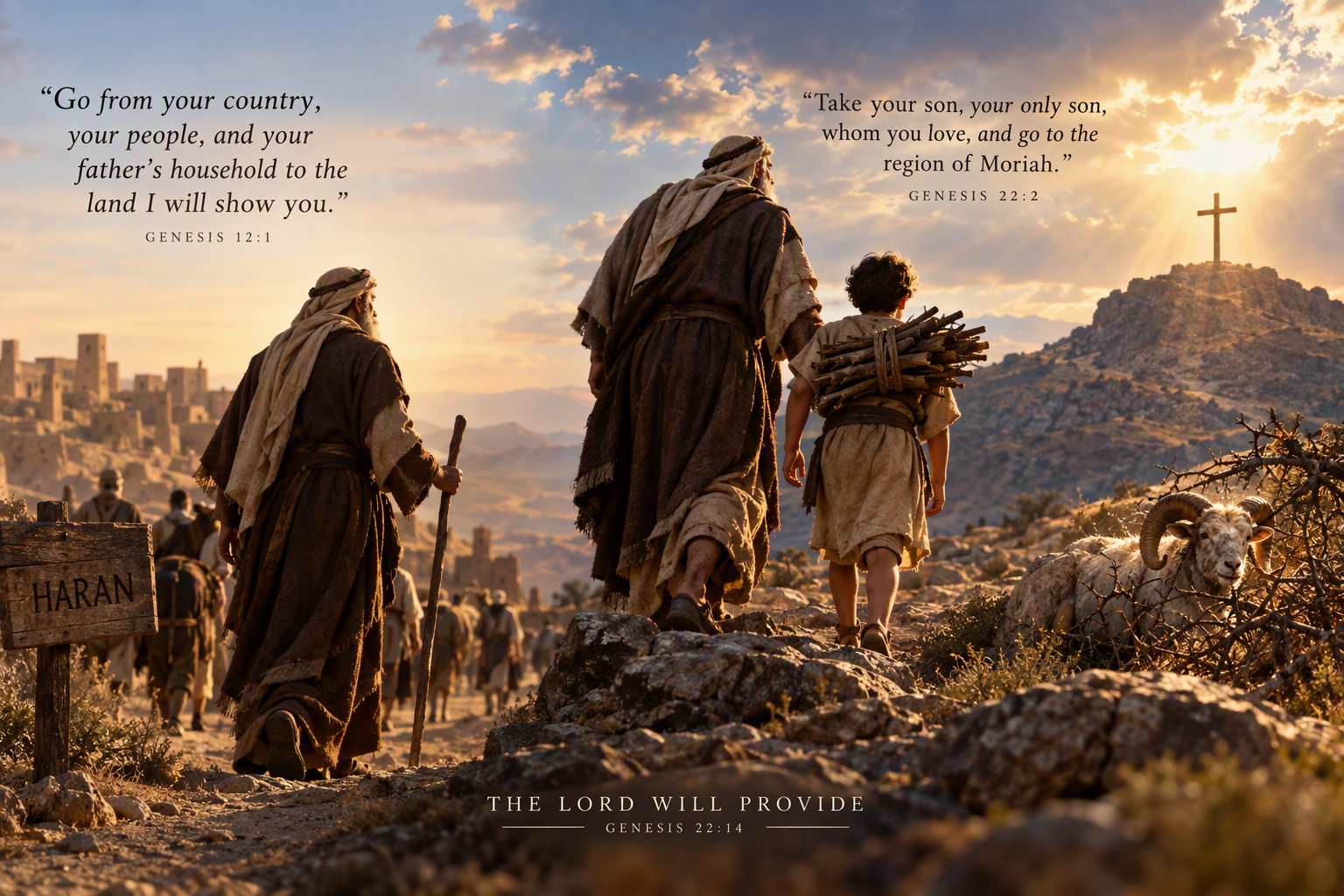
I have read the call of Abraham more times than I can count. "Go from your country, your people, and your father's household to the land I will show you." It is so familiar that for years I never stopped to ask the obvious question: why did he go?
I was taught, and I taught others, that Abraham went because he was a man of great faith. I still believe that. But the longer I sit with the text, the more honest I have to be about what it actually says.
The first "Go"
When God first speaks to Abram in Genesis 12, the command takes one sentence. The promises take two. A great nation. A blessing. A great name. Protection from his enemies. A future in which all the families of the earth would be blessed through him.
And Abram was a man with nothing to pass on. Just a few verses earlier, Scripture tells us plainly that Sarai was barren and had no child. Into that empty place God speaks the one word Abram most wanted to hear: descendants.
So he went. Genesis 12:4 says only that Abram left, as the Lord had told him. No speech, no altar yet, no recorded feeling. Just obedience, and a promise in his pocket.
I find myself asking whether he would have gone without the promise. I don't think the text wants me to answer too quickly. Later, in Genesis 15, Abram looks at God and asks, in effect, "What can You give me, since I remain childless?" That is not the prayer of a man who has outgrown the reward. That is the prayer of a man who is still waiting for it.
I am not troubled by this anymore. I am comforted by it. God did not wait for Abram's motives to be pure before calling him. God began with gifts, because God knew the man He was calling.
The second "Go"
Years pass. The promise is delayed, then delayed again. There are detours into Egypt, a shortcut through Hagar, laughter at the tent door. And then, at last, Isaac. The son. The promise with a face.
Then God speaks again, and the words sound almost the same: "Take your son, your only son, whom you love, Isaac, and go to the region of Moriah" (Genesis 22:2).
The first time, God named the things Abram was to leave behind: country, people, father's house. Each one was closer to his heart than the last. Now God names Isaac the same way: your son, your only son, the one you love. Each phrase tightens until it lands on the one name that holds every promise God ever made him.
The first time, the land was one God would show him. Now it is a mountain God will tell him. Again Abraham must walk without knowing exactly where he is going.
But this time there is no promise attached. No great nation. No great name. No blessing. Only the command, and the son he is being asked to give back.
What the two calls show me together
When I set these two calls side by side, I see something I missed for years. In Genesis 12, the promise comes first and the obedience follows. In Genesis 22, the obedience comes first, and only afterward does God speak the blessing: because you have done this, and have not withheld your son, I will surely bless you (Genesis 22:16–17).
The order has been reversed. The first call invited Abram to follow God toward the gift. The second asked Abraham whether he would follow God if it meant laying the gift down.
And notice how he answers. The first time, he simply went. This time, Scripture says he rose early in the morning (22:3). The man who once asked, "What will You give me?" now asks for nothing at all.
I cannot prove what was in Abraham's heart when he left Haran. But I believe Moriah reveals what grew there. It is the one test a man following only the reward could never pass.
On the mountain
I will be honest: this is one of the hardest stories in the Bible for me. How can Abraham's finest hour be the day he nearly sacrificed his own son? I have never found an answer that makes it easy, and I have stopped looking for one.
What I have come to believe is this. Moriah was Abraham's finest hour not because he was willing to harm his son, but because it was the day he chose the Giver over the gift. Everything God had promised him was bound up in Isaac. To walk up that mountain was to say, "Lord, if I must choose between Your promises and You, I choose You."
That is why the angel says, "Now I know that you fear God" (22:12). Not "now I know you want what I offer," but now I know you want Me.
And I hold on to how the story ends. God stops the knife. The God of Abraham is not a God who wants children on altars, and the rest of Scripture says so plainly. Abraham had told his son, "God Himself will provide the lamb" (22:8), and God did. Abraham named that place The Lord Will Provide.
I also notice three times in this chapter that Abraham says, "Here I am." He says it to God, he says it to Isaac, and he says it to the angel. Even on the worst road of his life, he stayed present. And twice Scripture says that father and son walked on together.
Where the story leads me
As a Christian, I cannot read Genesis 22 without seeing another hill. Isaac carries the wood up the mountain; centuries later, Jesus carries His cross up Golgotha. Abraham says God will provide the lamb; John the Baptist looks at Jesus and says, "Look, the Lamb of God, who takes away the sin of the world" (John 1:29).
The difference undoes me every time. On Moriah, God stopped the father's hand. At Calvary, no one stopped it. Paul writes that God did not spare His own Son but gave Him up for us all (Romans 8:32). What God would not ask of Abraham, He did Himself.
Hebrews 11 tells me Abraham went out not knowing where he was going, and that on Moriah he reasoned God could even raise the dead. His faith was never in the promise alone. It was in the God who makes and keeps promises.
What I have seen at the bedside
I think most of us come to God the way Abram left Haran. We are drawn by what He offers: healing, forgiveness, belonging, a future, relief from fear. I used to feel a little ashamed of that, as if real faith should have started somewhere higher. Abraham has shown me freedom from that shame. God called him anyway, and God calls us anyway.
But I have also learned, in my own life and in the lives of the people I serve, that faith does not stay in Haran. Sooner or later, many of us are led to a Moriah of our own. It is the hospital room, the empty crib, the diagnosis, the ministry that ended, the marriage we were sure God had given us. It is the moment when the very thing that held our faith together seems to be taken by the God who gave it.
I have learned not to rush people up that mountain. "The Lord will provide" is what Abraham said at the top, after three days of walking in silence. It is not something I hand to someone on their first day of grief. My calling is to walk the road with them, to say "here I am" the way Abraham did, and to let God name the place in His time.
I have also learned to be careful with this story. It has been used to tell hurting people that God demands their harm, or that their suffering is simply a test to pass. That is not the God I meet on Moriah. The God of this story stops the knife, provides the lamb, and in Christ gives His own Son rather than taking ours.
Two calls, one heart
The first time God said "Go," He asked Abram to leave his past behind. The second time, He asked Abraham to trust Him with his future. I believe that is the shape of a life of faith. We begin by following God for what He gives, and over a lifetime He teaches us to trust Him with everything He has given.
I am still learning that. Some days I am in Haran, holding onto the promise. Some days I am on the road to Moriah, not knowing how it will end. But I am more and more convinced that the God who called Abraham twice is the same God who calls me, and that on every mountain He has asked me to climb, He has already seen to the lamb.